Allen & Heath Qu-5, Qu-6 and Qu-7: The Best-Value Digital Mixer for Big Production?
Is the new Allen & Heath Qu series the best-value digital mixer for churches and live sound? What changed from the Qu-32, who it's not for, and rand prices.
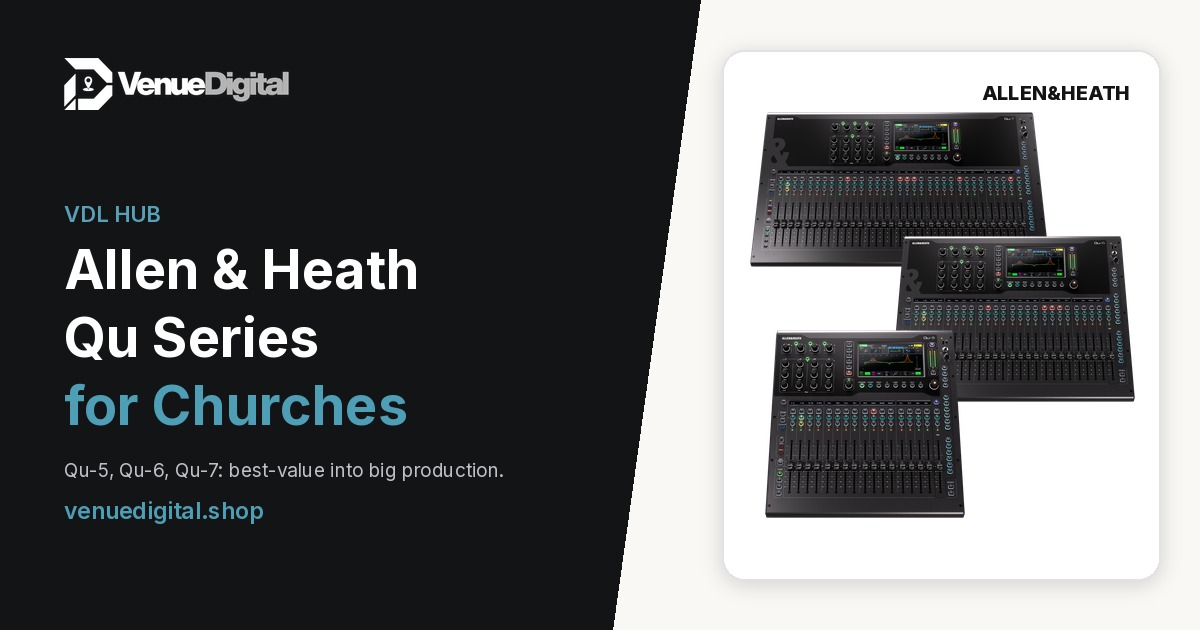
The short answer: the new Allen & Heath Qu series (Qu-5, Qu-6, Qu-7 and their Dante "D" versions) is, in our view, the best-value way into a digital mixer that can run a full production. Every model mixes 38 inputs to 12 mixes on a 96 kHz engine, records 32 tracks, and connects to stage boxes over one cable. You choose the frame size by how many faders and local inputs you want. The limit is 32 mono channels and 12 mixes, so a large band with lots of in-ear mixes will outgrow it. This guide covers what changed from the classic Qu-32, who it suits, who it doesn't, and what it costs in rand.
In this guide
- What the new Qu actually is
- What reviewers say, good and bad
- New Qu vs classic Qu-16/24/32: what changed
- Which frame size and which stage box
- What "big production" looks like on a Qu (a hypothetical)
- How it compares with the SQ-5, Midas M32 and Behringer Wing
- Who the Qu is not for
- Common mistakes we see
- Prices in rand
- FAQ
We sell and install everything mentioned here. Where another desk would suit you better, we'll tell you.
Start with what every new Qu has in common
Allen & Heath announced six new Qu mixers in May 2025, in three frame sizes, each with or without Dante (Allen & Heath). The important part for buyers: they share the same core. A Qu-5 mixes exactly as many channels as a Qu-7. What changes is the size of the surface and the number of sockets on the back.
| | Qu-5 / Qu-5D | Qu-6 / Qu-6D | Qu-7 / Qu-7D | |---|---|---|---| | Faders | 16+1 | 24+1 | 32+1 | | Local mic/line inputs | 16 | 24 | 32 | | XLR outputs | 12 | 16 | 20 | | Mixing core (all models) | 38 inputs to mix, 12 mixes + LR, 4 matrix, 6 FX engines | same | same | | Dante (D models only) | 16×16 | 16×16 | 16×16 |
Source: Allen & Heath Qu-5/6/7 Getting Started Guide.
So what? If you're a church with 14 inputs today but a growing band, a Qu-5 plus a stage box later gives you the same mixing power as a Qu-7. You only pay for faders you'll use.
Allen & Heath also added a Feedback Assistant and Gain Assistant, a 32-channel automatic mic mixer, and SD card recording of 32 channels at 48 kHz. For a volunteer team, the assistants matter most: they help set gains and pull out feedback before the service, not during it.
What reviewers say about the new Qu, good and bad
We've only quoted what we could check on the original page.
On value. Michael Lawrence, road-testing a Qu-7D for ProSoundWeb (6 October 2025), called the new range "a giant leap forward from the classic models" with "a very compelling price-to-performance value" (ProSoundWeb). He also notes he started weighing it against the SQ "despite the 2:1 price ratio".
Mark Woods, reviewing the Qu-5D for AudioTechnology (19 December 2025), wrote that it offers "much of the quality and functionality of their big-show consoles at a price I think people will be happy to pay" (AudioTechnology).
On big production. Woods used the Qu-5D at a four-day folk festival with "channel counts from two to near 30". A headline act's engineer had "the band's 28 channels together in no time" and called it "Helpful and forgiving". Mixdown's Qu-5D review (18 August 2025) said it "expands quickly from a tidy little mixer into something well and truly capable of mixing larger bands, groups and shows with ease" (Mixdown).
On volunteers. AudioTechnology says it is "easily apprehended by volunteers and part-timers". Churchfront's Qu-5D product page says "It is an approachable desk for volunteers" (Churchfront). In their May 2025 video, Churchfront say the new Qu "really changes the game" (Churchfront, YouTube, 20 May 2025).
On sound. Woods: "the Qu-5 is quieter than my CQ18-T and sounds slightly better", and other operators' comments "always started with 'it sounds great…'".
The caveats. These matter just as much:
- 32 mono channels. Churchfront: "only having 32 mono channels, you're going to start running out of room if you want to have your full modern worship band".
- Monitor mixes. Churchfront: if a church expects "a full band with many in-ear mixes, we usually point them to the SQ-5 instead".
- Dante is basic. ProSoundWeb: "The Dante interface is 16 x 16, regardless of the sampling rate (48 or 96 kHz), and is non-redundant."
- No built-in Wi-Fi. AudioTechnology lists "No onboard wi-fi antenna" as its one con, so budget for a router if you want to mix from an iPad.
- Small UI wrinkle. ProSoundWeb found the channel-naming pop-up's Next button discards your changes.
Sound On Sound has only covered the new range as news so far (19 May 2025), with no full review that we could find. We also found no Qu-5/6/7 content from MxU, MusicRadar, Mixing a Live, Pro Sound News or Audio Media International that we could verify.
New Qu vs classic Qu-16, Qu-24 and Qu-32: what changed?
The classic Qu range (Qu-16, Qu-24, Qu-32, Qu-Pac and Qu-SB) still exists as "Qu Classic", and Allen & Heath still updates its firmware. But it's a different platform. Here's the side-by-side, taken from Allen & Heath's pages:
| | Classic Qu (Qu-16 / 24 / 32 / Pac / SB) | New Qu (Qu-5 / 6 / 7, plus D) | |---|---|---| | Sample rate | 48 kHz | 96 kHz XCVI core | | Mono inputs to mix | 16 (Qu-16), 24 (Qu-24), 32 (Qu-32); Qu-Pac and Qu-SB 16, expandable to 32 | 32 on every model, plus 3 stereo | | Mixes | 4 mono + 3 stereo (Qu-16), +5 (Qu-24), +7 (Qu-32), plus LR | 6 mono + 6 stereo, plus LR, on every model | | Matrix | 2 stereo | 4 mono/linkable | | FX engines | 4 stereo RackFX | 6, with dedicated stereo returns | | Layers and labels | A fader per mono input on Qu-16/24/32, fewer layers | 4 customisable layers, display and chromatic meter on every channel | | Screen | Colour touchscreen | 7″ capacitive touchscreen | | Recording | Qu-Drive: 18 channels to USB; up to 32 tracks to a computer (Qu-32) | 32 channels to SD at 48 kHz (16 at 96 kHz), 32×32 USB-C | | Stage box port | dSNAKE: AB168, AR2412, AR84 | SLink: dSnake/ME at 48 kHz, DX and GX at 96 kHz | | Dante | Not listed on the classic pages | Built in on Qu-5D, Qu-6D and Qu-7D (16×16) | | Assistants | Automatic Mic Mixer (up to 16 mics) | Feedback Assistant, Gain Assistant, 32-channel automatic mic mixer |
Sources: Allen & Heath Qu Classic, Qu-16, Qu-24, Qu-32, Qu-Pac, Qu-SB, Qu-5/6/7 guide and Qu-5/6/7 connections.
What this means in practice:
- The small desk is no longer the cut-down desk. A classic Qu-16 mixed 16 mono channels. A Qu-5 mixes 32, if you add a stage box. AudioTechnology puts it simply: "Mix channels go from 22 to 38."
- The faders-per-channel idea has changed. The Qu-32 was loved because every mic had its own fader. Allen & Heath's cut-sheet says the Qu-7 "takes the ever-popular Qu-32 form factor", so you still get that on the Qu-7. On the Qu-5 and Qu-6 you'll use layers.
- Your old stage boxes may still work. If your church already has an AB168 or AR2412 from a classic Qu, the SLink port runs it at 48 kHz. Only one protocol can run on the port at a time, so you can't mix an old dSnake box and a DX168 on the same port.
Why the classic Qu-32 earned its reputation. In 2014 Church Production Magazine called the Qu-32 "truly a bargain" (Church Production). Audio Media International (23 November 2014) said its fader count "helps prevents layeritis" (AMI). Sound On Sound's Qu-16 review (January 2014) summed it up as "Compact yet powerful and affordable" (Sound On Sound). Not everyone agreed: Churchfront said of the classic models, "I'm never going to recommend this for most churches." The new range is the version that changed their mind.
Price positioning. We don't sell the classic Qu any more, so we can't give you a current rand comparison. On the new range, ProSoundWeb says the Qu-7D costs "about half of what you will pay for an SQ unit of the same frame size plus the Dante card". Our own prices are below.
Choose the frame size by faders, then the stage box by distance
Qu-5 (16+1 faders). For a speech-led church, a school hall, a conference room or a small band. It can be rack-mounted with an optional kit. Add a stage box later if you outgrow 16 local inputs.
Qu-6 (24+1 faders). For a mid-size band where you want most inputs on the top layer.
Qu-7 (32+1 faders). For the volunteer who came from analogue and wants every mic in front of them, like the Qu-32.
The D models. Choose a D if you'll connect to Dante: a livestream or recording computer, Dante wireless receivers, or a Dante speaker processor. Mixdown points out that Dante "can't be equipped" on a non-D Qu "after the fact", so decide now.
Stage boxes that work with the new Qu, per Allen & Heath's DX & GX system guide and dSnake configurations:
- DX168 (16 in / 8 out, 96 kHz). The natural match. Two can be cascaded on one SLink port for 32 extra inputs.
- GX4816 (48 in / 16 out, 96 kHz). One per Qu. Overkill for most small rooms, but it lets a Qu-5 mix 32 mics from stage.
- AR2412 or AB168 (dSnake, 48 kHz). Fine if you already own one.
What "big production" looks like on a Qu (a hypothetical)
Picture a 300-seat church in a converted warehouse. This is a hypothetical, not a client. There are drums, bass, two guitars, keys, four vocals, a pastor's headset, a lectern mic and a playback laptop, so around 26 inputs.
On a Qu-6 with a DX168 on stage, the band goes into the stage box and the speech mics into the desk. One Cat cable runs to the back. The 12 mixes might cover four wedge or in-ear mixes, a stereo livestream mix, a foyer feed and a recording send. Scenes recall the worship set and the sermon, and the SD card records everything for Tuesday's practice.
That's a real production on an entry-level desk. It's also close to the ceiling. Add a second drummer's worth of mics or six more in-ear mixes and you're into SQ territory.
How does it compare with the SQ-5, Midas M32 and Behringer Wing?
If you need more monitor mixes or more channels: the Allen & Heath SQ-5 mixes 48 channels on a 96 kHz engine, with 16+1 faders and 16+1 preamps (Allen & Heath). In our catalogue it costs about the same as a Qu-6. So the real choice is a Qu-6's 25 faders and local inputs against the SQ-5's larger mixing engine in a smaller frame.
If your engineers already know the X32/M32 workflow: we stock the Midas M32 LIVE and M32R LIVE. We haven't found a current, verifiable head-to-head review against the new Qu to quote, so we'd compare them with you in person.
If you want the most features per rand and have a confident tech: Churchfront says the Behringer Wing "offers a lot of capability for its price" (Churchfront). We don't stock it, but it's worth a look.
We found no reputable current comparisons with the Yamaha TF or Soundcraft's digital desks to cite.
Who the Qu is not for
- Churches with a full modern band and a fully mic'd drum kit. 32 mono channels runs out quickly.
- Teams that need more than about six individual in-ear mixes plus a livestream. Twelve mixes go fast. Look at the SQ.
- Installs that need redundant Dante. The D models' Dante is 16×16 and non-redundant.
- A single speaker and a playback laptop. You don't need a 96 kHz desk. A smaller CQ mixer will do.
Common mistakes we see
- Buying faders before counting inputs. List every mic, DI and playback source, then add a few spares.
- Choosing a non-D model, then wanting Dante. It can't be added later.
- Forgetting the livestream mix. The house mix rarely sounds right on a phone. Plan an output for it.
- Not building scenes. A volunteer should walk in on Sunday, recall the scene and start from a known-good mix.
- Upgrading the mixer to fix a room problem. If the back rows can't hear clearly, no desk will fix that. Sort the speakers and the room first.
What does a new Qu system cost in rand?
Prices as listed at time of writing (October 2026). All are available to order, so check lead time with us.
| Product | Price | |---|---| | Allen & Heath Qu-5 | R40,972 | | Allen & Heath Qu-5D | R46,947 | | Allen & Heath Qu-6 | R55,995 | | Allen & Heath Qu-6D | R62,395 | | Allen & Heath Qu-7 | R66,582 | | Allen & Heath Qu-7D | R74,695 | | Allen & Heath DX168 Audio Expander | R30,895 | | Allen & Heath GX4816 Audio Expander | R81,995 | | Allen & Heath AR2412 AudioRack | R27,315 | | Allen & Heath Qu-5 Rack Mount Kit | R1,095 | | Allen & Heath SQ-5 (for comparison) | R55,484 |
Two decisions worth framing:
- Dante costs about R6,000 to R8,000 more in each frame size. Pay it if Dante is in your plans in the next few years.
- A Qu-5 plus a DX168 comes to about R72,000. That's about R5,000 more than a Qu-7 and gives you the same 32 inputs, with 16 of them on stage. Choose by whether you want 33 faders at the desk or a stage box on the platform.
Delivery is free on orders over R2,500. Returns are accepted within 7 days, with the customer paying return shipping.
Next steps
Before you contact anyone, list every input you use on a typical Sunday, count how many separate mixes you need (monitors, livestream, foyer), and decide whether anything in your building runs on Dante. Those three answers decide between a Qu-5, Qu-6, Qu-7 and an SQ quickly.
When you're ready, request a quote and we'll help you size the desk and stage box.
FAQ
What's the difference between the Qu-5, Qu-6 and Qu-7?
Only the frame size. All three mix 38 inputs to 12 mixes on the same 96 kHz core. The Qu-5 has 17 faders and 16 local inputs, the Qu-6 has 25 and 24, and the Qu-7 has 33 and 32.
What does the "D" mean on the Qu-5D, Qu-6D and Qu-7D?
It means a built-in 16×16 Dante interface at 48 or 96 kHz. It can't be added to a non-D model later, so choose it upfront if you'll use Dante.
Is the Qu-7 the replacement for the Qu-32?
Yes, in practice. Allen & Heath says the Qu-7 takes the Qu-32 form factor and adds the 96 kHz XCVI core, new FX and Everything I/O connectivity. The Qu-32 is now part of the Qu Classic range.
Will my old AB168 or AR2412 stage box work with a new Qu?
Yes. The SLink port runs dSnake boxes at 48 kHz. For 96 kHz, use a DX168 or GX4816. Only one protocol can run on the port at a time.
Can a new Qu run a full worship band?
Yes, up to a point. With 32 mono channels and 12 mixes it handles most bands. A large band with a fully mic'd kit and many in-ear mixes will outgrow it, and that's when we'd look at the SQ range.
Should we buy a new mixer or fix our speakers first?
Fix the speakers and the room first if the problem is muddy or uneven sound. A new mixer helps with workflow, scenes and recording, but it won't fix coverage.
FAQ
What's the difference between the Qu-5, Qu-6 and Qu-7?
Only the frame size. All three mix 38 inputs to 12 mixes on the same 96 kHz core. The Qu-5 has 17 faders and 16 local inputs, the Qu-6 has 25 and 24, and the Qu-7 has 33 and 32.
What does the D mean on the Qu-5D, Qu-6D and Qu-7D?
It means a built-in 16x16 Dante interface at 48 or 96 kHz. It can't be added to a non-D model later, so choose it upfront if you'll use Dante.
Is the Qu-7 the replacement for the Qu-32?
Yes, in practice. Allen & Heath says the Qu-7 takes the Qu-32 form factor and adds the 96 kHz XCVI core, new FX and Everything I/O connectivity. The Qu-32 is now part of the Qu Classic range.
Will my old AB168 or AR2412 stage box work with a new Qu?
Yes. The SLink port runs dSnake boxes at 48 kHz. For 96 kHz, use a DX168 or GX4816. Only one protocol can run on the port at a time.
Can a new Qu run a full worship band?
Yes, up to a point. With 32 mono channels and 12 mixes it handles most bands. A large band with a fully mic'd kit and many in-ear mixes will outgrow it, and that's when we'd look at the SQ range.
Should we buy a new mixer or fix our speakers first?
Fix the speakers and the room first if the problem is muddy or uneven sound. A new mixer helps with workflow, scenes and recording, but it won't fix coverage.