Point Source Speakers for Churches: When to Choose Point Source, Column or Line Array
What is a point source speaker, and does your church need one or a line array? Plain advice on room size, coaxial speakers and rand prices for SA churches.
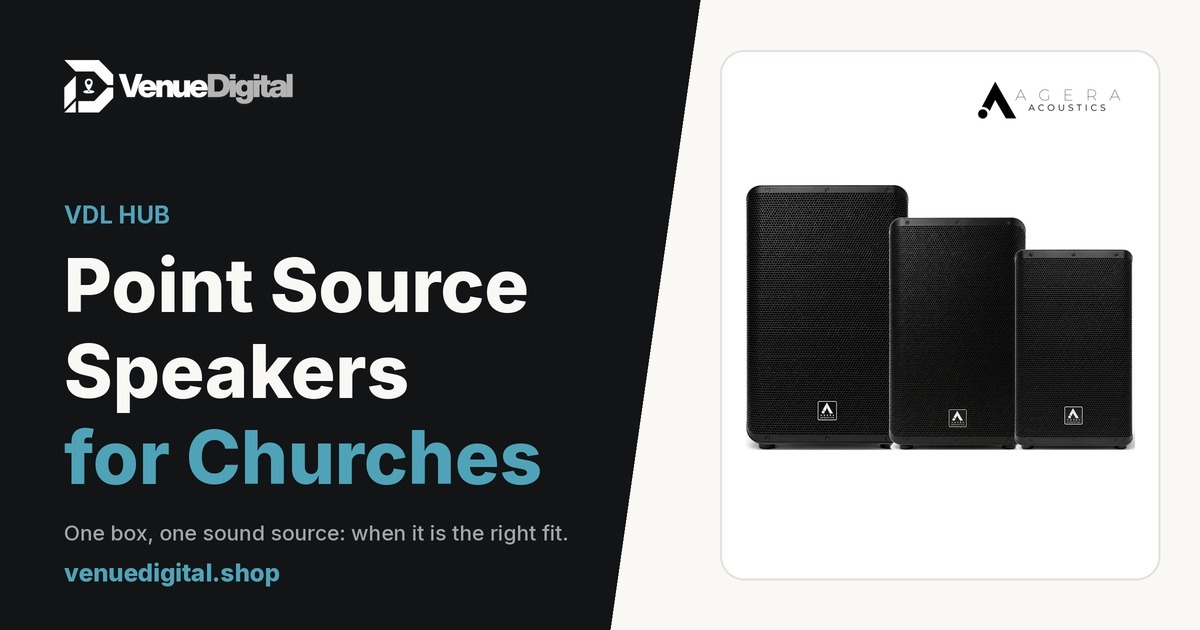
A point source speaker is a single box where all the sound spreads out from one point. For most small to medium churches, a pair of good point source speakers (one per side, with subs if you have a band) is the simplest system that does the job. The trade-off is reach: a point source gets about 6 dB quieter every time the distance doubles, so in a big or long room a line array usually works better. This guide explains how to tell which one your room needs, where column speakers fit in, and why a coaxial point source is worth a look.
In this guide
- What is a point source speaker?
- Why level drops off with distance, and why it matters on Sunday
- Point source or line array: start with the room
- Where do column speakers fit?
- Why coaxial point source speakers sound more even
- What a point source system looks like, priced in rand
- Common mistakes we see
- FAQ
We sell and install everything mentioned here. Where another type of speaker or another brand would suit you better, we'll tell you.
What is a point source speaker?
A point source speaker is the "normal" PA speaker most people picture: one box, with the sound radiating out from a single point. In a church that usually means one box on each side of the stage, on stands or mounted, with or without subwoofers underneath.
Its biggest strength is simplicity. One box per side is quick to set up and easy for volunteers to understand, which matters when the same team sets up in a school hall every Sunday and packs down afterwards.
Why does sound drop off with distance, and why does it matter on Sunday?
Every time you double the distance from a point source speaker, the level drops by about 6 dB. That's basic physics (the inverse-square law), and it's documented in technical papers from Bose and JBL Professional.
Here's what that means in a church. Taking someone 2 m from the speaker as the starting point:
| Distance from speaker | Level compared to 2 m | |---|---| | 2 m | 0 dB | | 4 m | about −6 dB | | 8 m | about −12 dB | | 16 m | about −18 dB |
In a short room that's no problem. In a long room it's the familiar Sunday complaint: the front rows say it's too loud, and the back rows still can't follow the sermon. Turning it up only makes the front louder.
Point source or line array: start with the room, not the speaker
A line array is a column of speaker modules working together. In its near field, a line array loses only about 3 dB per doubling of distance instead of 6 dB (further out, it also drops by 6 dB). Yamaha and the JBL paper above both explain this. In practice, the level at the back stays closer to the level at the front.
So the rule of thumb from the reel holds:
- Small to medium room: point source. It's simpler, costs less and is easier for volunteers.
- Big or long room: line array. It keeps the level more even from front to back.
These are general guidelines, not ratings for any particular product. No manufacturer we stock gives a "seats per speaker" figure we'd want to quote, and room shape matters as much as seat count. A balcony, a low ceiling or a very long, narrow warehouse can push a mid-sized church towards a line array.
Line arrays aren't automatically the right answer either. They cost more, usually need rigging and need proper set-up to sound right. Churchfront makes the same point, saying line arrays are "not automatically the right answer".
When a line array is the right call, it can still be compact. One example is the Agera Acoustics LA-206A line array.
Where do column speakers fit?
Column speakers sit between the two. They're tall, slim systems, usually with a matching sub and a small built-in mixer, built to be carried in, set up quickly and packed away. That makes them a popular choice for churches that meet in halls, tents or rented venues.
Our current column options include the HK Audio POLAR 10 MKII (R20,399), the Turbosound iP1000 V2 (R26,999) and the Agera CA-12A (R15,999). They all list a 4-channel mixer or similar built-in features in their catalogue descriptions, which is handy for a small service with a few mics.
The limitation: a 4-channel built-in mixer is fine for a pastor and a couple of singers, but a full band still needs a proper mixer. Columns are also not a substitute for a line array in a large room. How evenly a column covers a room depends on the model, so ask for the manufacturer's coverage information before you buy one for a long room.
Why do coaxial point source speakers sound more even?
Most PA speakers have a separate woofer (low frequencies) and tweeter or horn (high frequencies), mounted one above the other. That gives you two sound sources. Where their frequency ranges overlap, they can clash, so the tone and level change as you move off-centre. Tannoy and FOH Magazine both describe this: Tannoy mentions a "suck-out" around the crossover, and FOH Magazine calls it lobing.
A coaxial speaker nests the high-frequency driver in the centre of the low-frequency driver. The sound comes from one acoustic centre, time-aligned, so the tone stays much the same whether you're sitting dead centre or off to the side. For a church, that's the person in the side section who hears the same sermon as the person in the middle.
What this looks like in practice: the Agera SWC PRO range. Agera describes the SWC-15A PRO as an active 15″ two-way coaxial speaker with "consistent and symmetrical sound dispersion". It also comes in 12″ and 10″ versions:
- SWC-15A PRO (15″ coaxial): our listing gives up to 1,800 W RMS of Class-D power, so it has headroom for a band as well as speech. It measures 410 × 660 × 390 mm and weighs about 21 kg, so it's a two-hand lift onto a stand.
- SWC-12A PRO (12″ coaxial, 350 × 580 × 350 mm).
- SWC-10A PRO (10″ coaxial, 310 × 500 × 300 mm).
For more low end, Agera pairs the SWC-15A PRO with the SWC-18AD PRO 18″ active subwoofer.
The limitation: these are still point source speakers, so the 6 dB-per-doubling rule applies to them. Agera doesn't publish a coverage angle or a recommended room size for this range. We'd plan the system around your room on a site visit rather than guess from a spec sheet.
Not for you if: your room is big or long enough that the back rows are much further away than the front. Look at a line array instead.
Coaxial isn't the only good option, either. Conventional two-way speakers such as the EV ZLX-12P-G2 (R12,995) or the Wharfedale Pro Titan AX12 (R6,399) do a good job in plenty of small churches. Choose for the room and the budget, not the badge.
What does a point source system look like, priced in rand?
A hypothetical example: picture a church that meets in a medium-sized hall, with a worship band on Sundays and a midweek service with just the pastor and a keyboard. A sensible point source system is one coaxial top and one sub on each side of the stage.
Prices are from our catalogue at time of writing (October 2026) and may change.
| Qty | Product | Unit price | Line total | |---|---|---|---| | 2 | Agera SWC-15A PRO 15″ active coaxial speaker | R10,999 | R21,998 | | 2 | Agera SWC-18AD PRO 18″ active subwoofer | R17,999 | R35,998 | | | Total | | R57,996 |
Not included: mixer, microphones, cables, stands or poles, delivery and installation. We quote those once we know your room. All four products are listed as "available to order", so we'll confirm lead time when we quote.
Speech-led or smaller room? You might not need subs at first. Two SWC-12A PRO tops come to about R20,000, or two SWC-10A PRO tops to about R18,000. You can add subs later when the band grows.
Don't buy yet if: your main problem is echo. In a hard, bare hall, a more powerful speaker often just makes the echo louder. Get the speakers aimed at the people (not the walls), and look at room treatment before you upgrade the boxes.
Common mistakes we see
- Turning up to reach the back. With a point source, that mainly makes the front rows louder. If the back can't hear, look at the speaker positions, add delay speakers or consider a line array.
- Buying a line array for a room that doesn't need one. In a small room, it adds cost and complexity for little gain.
- Choosing by wattage. Watt figures are measured differently by different makers. Choose for the room, the type of service and coverage.
- Aiming speakers at the walls. Point the boxes at the congregation, slightly toed in, so less sound bounces off hard surfaces.
- Forgetting the volunteers. The best system is one your team can set up the same way every week.
Next steps
Before you talk to anyone about speakers, do this homework:
- Measure the room: length, width and ceiling height, in metres.
- Note the distance from the stage to the back row.
- Take three photos from the back of the room and one from the stage.
- Write down what happens on a typical Sunday: speech only, a few singers, or a full band.
- Note whether the system stays up or gets packed away after each service.
If your team runs a livestream, our Stream Audio Academy teaches volunteers to build a proper stream mix.
Venue Digital also offers finance for churches that want to spread the cost. You can mention it when you request a quote.
Request a Quote → Send us your measurements and photos, and we'll tell you whether point source, column or line array suits your room.
FAQ
What is a point source speaker?
A point source speaker is a single box where all the sound radiates from one point. It's the standard PA speaker most churches use, usually one per side of the stage. It's simple to set up, but it gets about 6 dB quieter each time the distance doubles.
Do we need a line array for our church?
Probably not, if your room is small to medium. A pair of good point source speakers covers most of those rooms well. A line array earns its cost in big or long rooms, where it keeps the level more even from the front row to the back.
What's the difference between a column speaker and a normal PA speaker?
A column speaker is a tall, slim system, usually with a matching sub and a small built-in mixer, built to set up and pack away quickly. A normal (point source) PA speaker is a single box, and you choose the mixer and subs separately. Columns suit portable churches with simple services. Point source tops with a separate mixer suit churches with bands.
Why does it matter that a speaker is coaxial?
A coaxial speaker has its high-frequency driver in the centre of its low-frequency driver, so all the sound comes from one acoustic centre. That keeps the tone more consistent as you move off-centre, so people in the side sections hear much the same as those in the middle. It's a nice advantage, but room size still decides between point source and line array.
Do we need subwoofers with point source speakers?
Not always. For speech and a keyboard, full-range tops on their own are often enough. Add subs when you have a band with drums and bass, and you can always add them later.
Should we upgrade our speakers or fix the room first?
Check the room and the set-up first. If the problem is echo or speakers aimed at the walls, bigger speakers can make it worse. Re-aim the speakers, deal with the worst hard surfaces, and then decide whether you need new boxes.